Frankenstein
Mary Wollstonecraft Shelley · first published 1818
The most filmed novel in this library, and almost none of it looks like the book.
35 versions · 1910–2025 · screen, stage, drawn
The stage got there first. In 1823, five years after publication, London saw Presumption; or, The Fate of Frankenstein, and Mary Shelley went along to watch. The play took two decisions the novel had not: it struck the creature dumb, and it gave the making of him a scene. Both stuck.
That is why the twentieth century inherited a mute, lumbering monster from a book in which the creature is appallingly articulate — he reads Milton, argues his case, and wins the argument — and in which his making occupies about a paragraph. Edison’s studio filmed it in 1910; Universal made the face everyone now pictures in 1931; Guillermo del Toro returned to it in 2025.
The book is stranger than any of them, and much colder. It is told at three removes, opens and closes in the Arctic, and spends its longest stretch on the creature’s own account of learning to speak by watching a family through a wall.
Written in the summer that never came
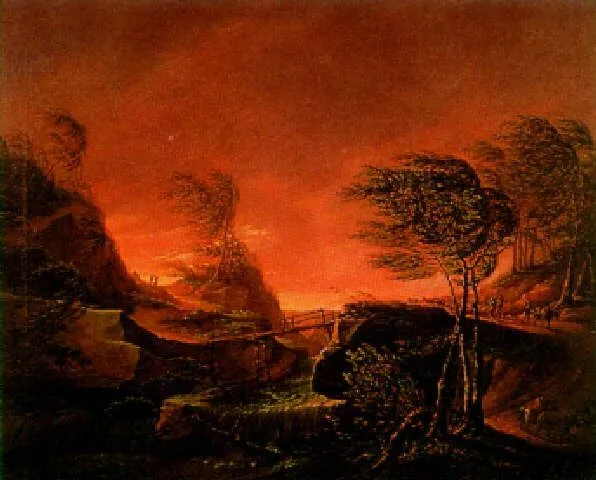
In April 1815 Tambora erupted in the Dutch East Indies, throwing enough ash into the atmosphere to cool the whole northern hemisphere. 1816 became the year without a summer: crops failed across Europe and North America, bread prices doubled, and it rained for weeks on end. Mary Godwin was eighteen, on the shore of Lake Geneva with Percy Shelley and Byron, and the weather kept the party indoors. Byron proposed they each write a ghost story.
What she wrote came out of the other obsession of those years. Galvani had made dead frogs’ legs kick with electricity in the 1780s; his nephew Aldini took the demonstration further, and in London in 1803 applied a battery to the corpse of a hanged murderer in front of an audience, making the jaw work and one eye open. Anatomy schools were buying bodies faster than the law could supply them, and the trade in stolen corpses was a public scandal.
So the novel’s question was not idle when it was asked. Electricity had just been shown to move dead flesh, the dead were being dug up for money, and a cold sunless year had made the future look uncertain. The book was published in 1818, anonymously, when its author was twenty.
On screen
30Film and television, earliest first.
- 1910 Frankenstein J. Searle Dawley
- 1915 Life Without Soul Joseph W. Smiley
- 1920 The Monster of Frankenstein Eugenio Testa
- 1932 Frankenstein James Whale
- 1939 Son of Frankenstein Rowland V. Lee
- 1957 The Curse of Frankenstein Terence Fisher
- 1967 Frankenstein Conquers the World Ishirō Honda
- 1971 Frankenstein Must Be Destroyed Terence Fisher
- 1973 Frankenstein Glenn Jordan
- 1973 Frankenstein: The True Story Jack Smight
- 1975 Young Frankenstein Mel Brooks
- 1977 Victor Frankenstein Calvin Floyd
- 1979 Flesh for Frankenstein Antonio Margheriti
- 1984 Frankenstein James Ormerod
- 1984 Frankenstein 90 Alain Jessua
- 1985 The Bride Franc Roddam
- 1987 Frankenstein Burt Brinckerhoff
- 1988 Frankenstein General Hospital Deborah Sahagun
- 1992 Frankenstein David Wickes
- 1995 Mary Shelley's Frankenstein Kenneth Branagh
- 2004 Frankenstein Marcus Nispel
- 2007 My Name Is Bruce Bruce Campbell
- 2010 Bikini Frankenstein Fred Olen Ray
- 2010 The Frankenstein Syndrome Sean Tretta
- 2011 Frankenstein: Day of the Beast Ricardo Islas
- 2014 Army of Frankensteins Ryan Bellgardt
- 2015 Frankenstein Bernard Rose
- 2016 Victor Frankenstein Paul McGuigan
- 2025 Frankenstein Guillermo del Toro
- — Frankenstein Kevin Connor
On stage
3Opera, musical theatre and ballet made from it.
- 2010 Frankenstein Mark Grey
- — Frankenstein – A New Musical
- — Mer de glace Richard Meale
Drawn
2Comics and manga.
- 2018 Frankenstein
- — Victor LaValle's Destroyer
Versions are listed where they are documented. A century of stage productions and most broadcasts were never catalogued at all, so this is what can be shown rather than everything that was ever made.